Best Practices in Broiler Poultry Supply Chain Management
A comprehensive analysis of how the world's leading broiler-producing nations — the United States, Brazil, Canada, the European Union, and Thailand — design, govern, and protect their poultry supply chains against disease, market shocks, and structural disruptions.
The Modern Broiler Value Chain
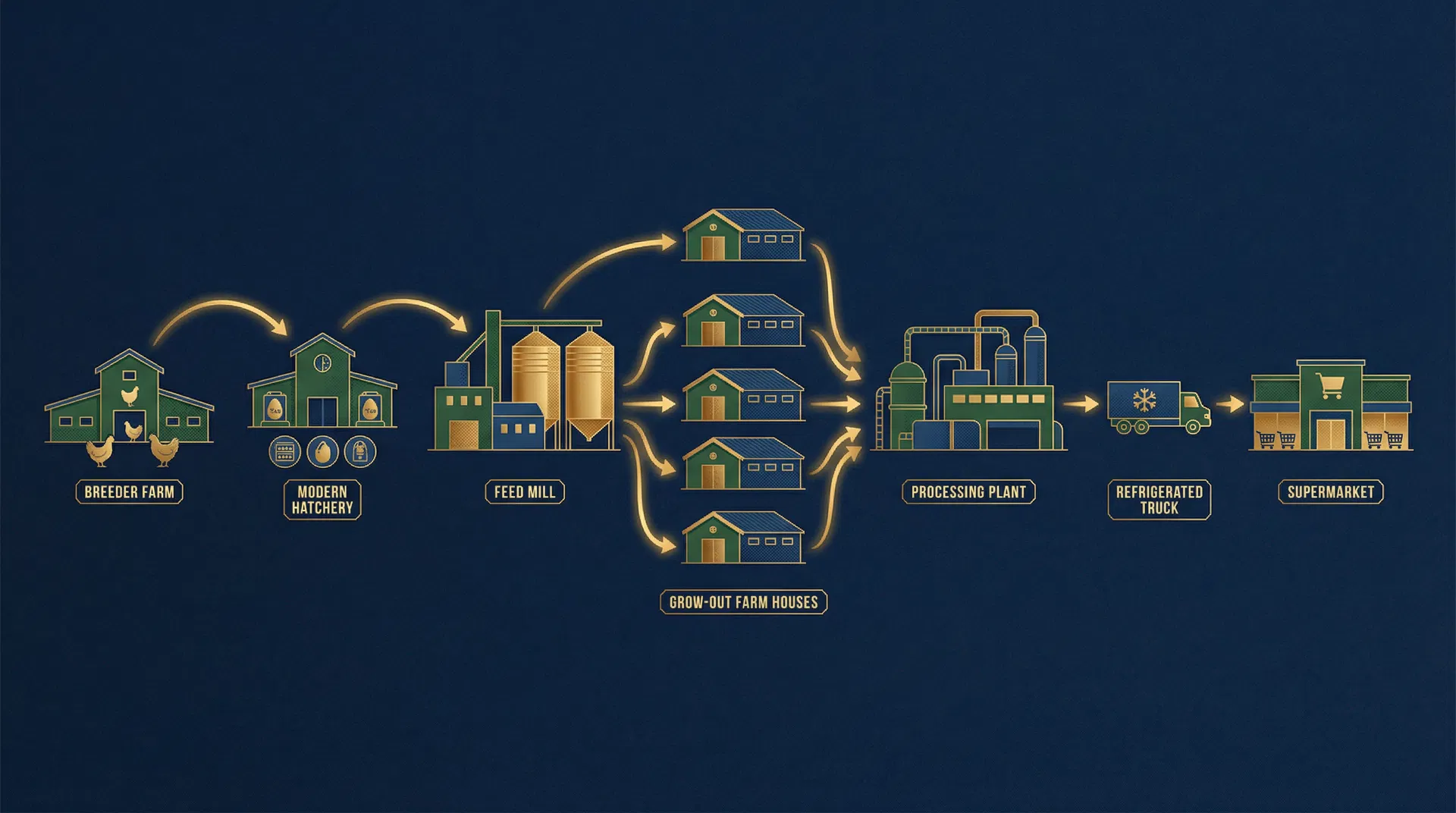
From primary breeding genetics to the retail shelf, the broiler supply chain spans seven distinct stages — each with its own actors, outputs, and risk profile.
| Stage | Key Actors | Primary Risk |
|---|---|---|
| Primary Breeding | Aviagen, Cobb-Vantress (global genetics) | Genetic disease, biosecurity breach |
| Hatchery | Integrators or independent hatcheries | Disease transmission, chick quality |
| Feed Mill | Integrators or independent mills | Ingredient price volatility, contamination |
| Grow-Out Farm | Contract growers or company farms | Disease outbreak, climate stress, mortality |
| Processing Plant | Integrators or independent processors | Labor disruptions, contamination |
| Cold Chain Logistics | 3PL providers, integrator fleets | Temperature excursions, transport delays |
| Retail / Foodservice | Supermarkets, QSR chains, distributors | Demand shocks, price volatility |
The Six Foundational Pillars
The world's leading broiler-producing nations converge on six pillars that together ensure continuous national supply without shocks or disease-driven disruptions.
Vertical Integration & Contract Farming
The most transformative structural innovation in modern broiler supply chain management. Integrators own or control breeders, hatcheries, feed mills, and processing plants while contracting grow-out to independent farmers.
Production Planning & Quota Management
Whether through market-driven planning (US, Brazil, EU) or quota-based supply management (Canada), the most resilient supply chains base production decisions on accurate, timely demand data.
Biosecurity & Disease Prevention
Biosecurity is the single most important operational practice for preventing supply shocks caused by disease outbreaks. Prevention costs a fraction of outbreak response.
Surveillance, Early Warning & Emergency Response
Early detection is critical to limiting spread and economic impact. Leading nations invest heavily in active and passive surveillance systems that provide real-time visibility into flock health.
Digital Technologies & Industry 4.0
IoT sensors, AI demand forecasting, blockchain traceability, and ERP systems multiply the effectiveness of all other pillars.
Regulatory Frameworks & Trade Measures
Effective regulation is the institutional backbone of a resilient broiler supply chain — establishing minimum standards, creating transparency, and providing the legal basis for emergency interventions.
How Quotas Are Decided & Managed
Canada's supply management system is the world's most institutionally developed quota-based production planning model — operating without government subsidies for over 50 years.
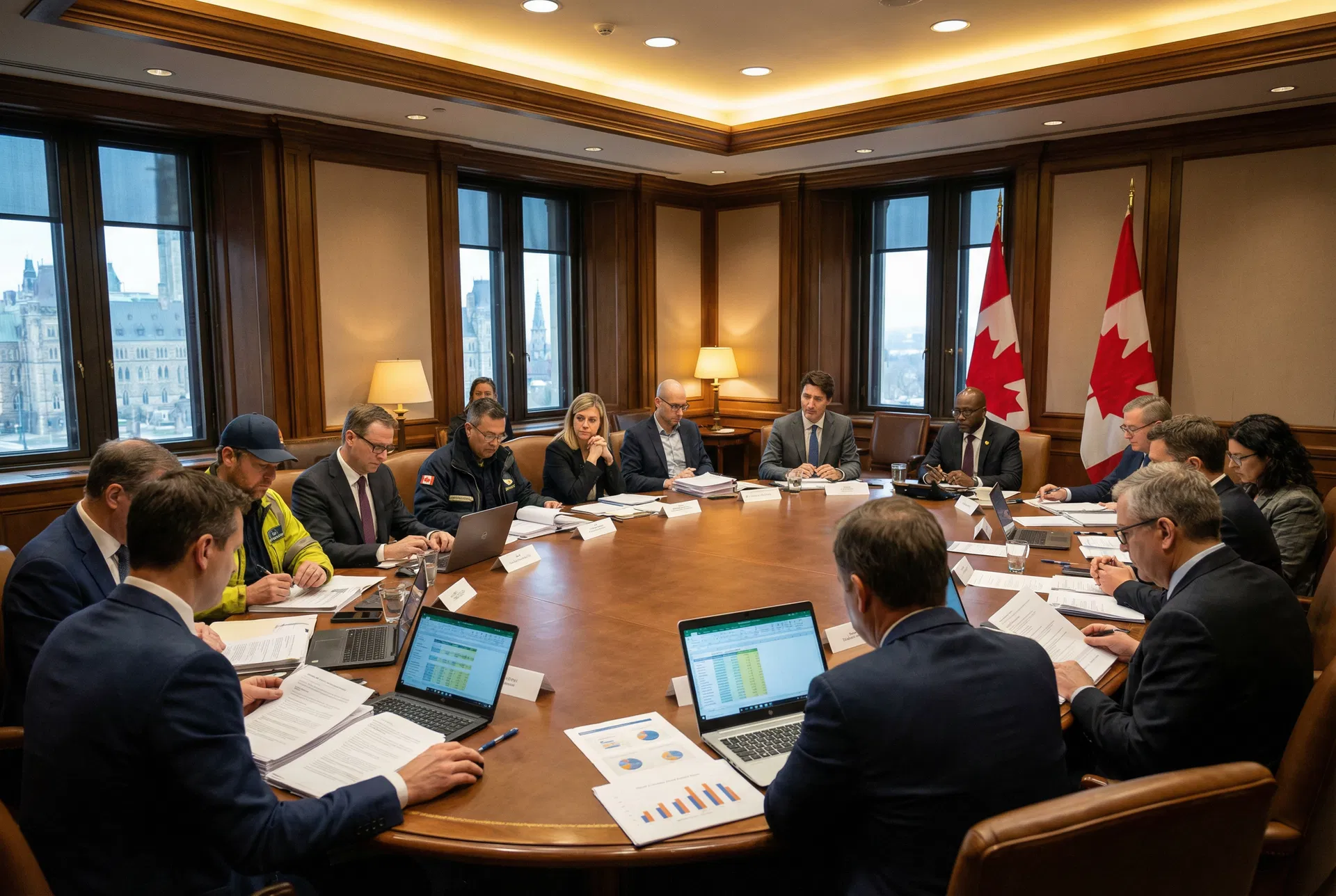
The Chicken Farmers of Canada (CFC) Directors meet every eight weeks to determine the national production allocation. The system rests on three equally important pillars: production planning, import controls, and producer pricing.
The eight-week planning cycle works as follows: CFC collects data on current consumption trends, processor inventory levels, retail pricing, and export volumes. Each provincial marketing board submits a production request. CFC Directors then set the national allocation as a percentage above or below the "base" production level.
Import controls use tariff rate quotas with over-quota tariffs exceeding 200% to ensure imports remain predictable, allowing domestic production planning to function without being undermined by import surges.
Demand Assessment — CFC collects consumption, inventory, pricing, and export data
Provincial Requests — each provincial board submits production requests
National Allocation Decision — Directors set % above/below base
Provincial Distribution — allocation distributed by Market Sharing Quota (MSQ)
Individual Quota Allocation — provincial boards allocate to quota-holding farmers
Enforcement — processors pay regulated minimum price; disciplines prevent over-production
Prevention Over Response
The economic logic is compelling: preventing a disease outbreak costs a fraction of the economic damage caused by one.
All-In, All-Out System
All birds in a house are placed and removed simultaneously. The house is then thoroughly cleaned, disinfected, and rested before the next flock — eliminating cross-contamination between age cohorts.
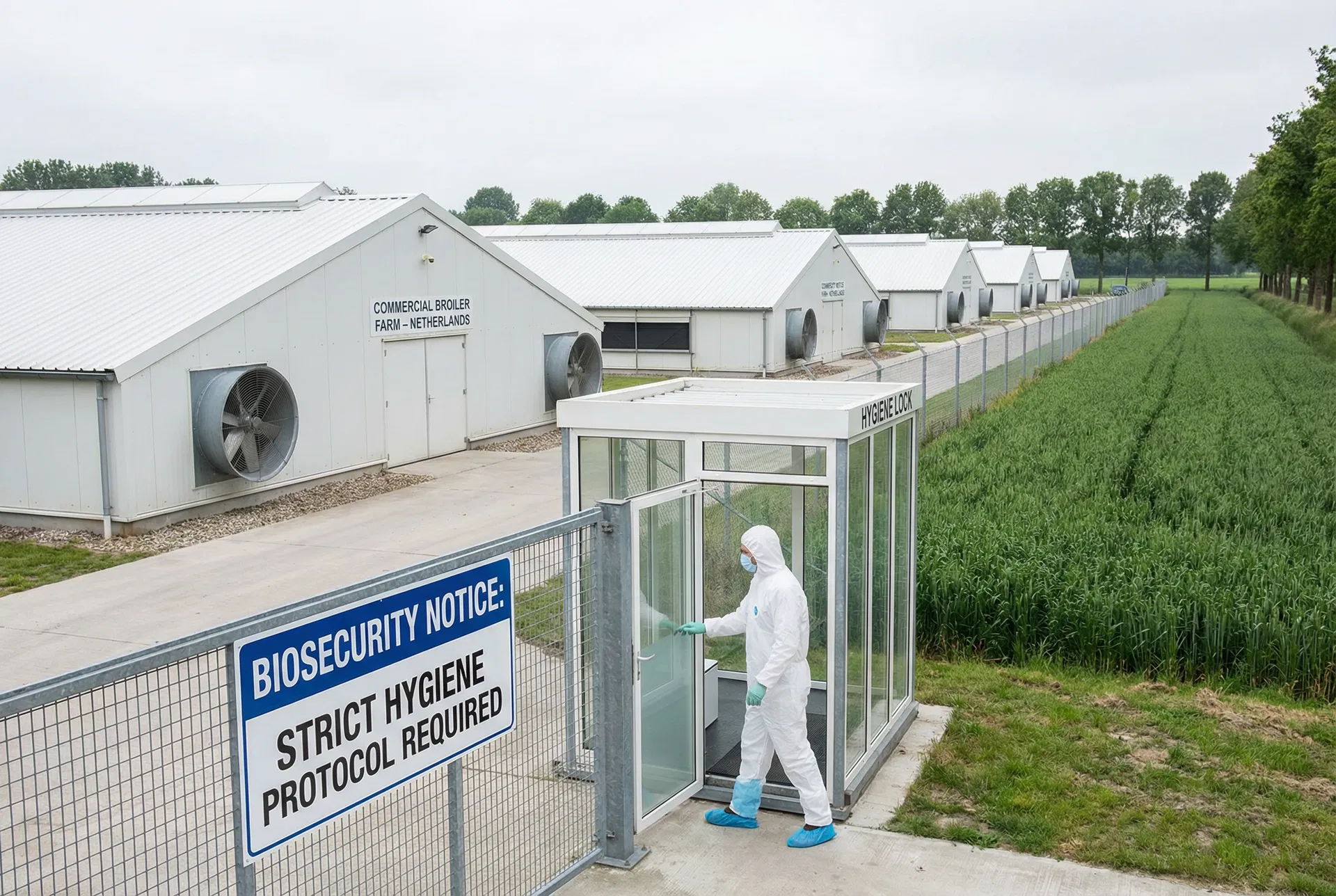
Physical Barriers & Hygiene Locks
Enclosed, climate-controlled houses with controlled-access entry points. Workers shower, change into dedicated clothing, and disinfect before and after contact with birds.
Heat-Treated Feed
Feed is pelleted at high temperatures to eliminate bacterial pathogens such as Salmonella before reaching the birds. Feed mills operate under strict sanitation protocols.
Compensation as Disease Control
Thailand's post-HPAI lesson: when farmers are fully compensated for culled birds, they report sick birds immediately. Without compensation, disease spreads undetected.
Global Early Warning Systems
No national biosecurity system can be effective in isolation. International surveillance integration is non-negotiable.
World Animal Health Information System
WOAH Members have a legal obligation to submit immediate notifications of HPAI outbreaks within 24 hours of confirmation. WAHIS provides real-time alert notices and six-monthly disease monitoring reports.
Visit resourceEmergency Prevention System for Animal Health
FAO's global animal disease information system providing early warning, early reaction, and progressive control of transboundary animal diseases. Supports national veterinary services with regional and global disease information.
Visit resourceNational Poultry Improvement Plan
A federal-state-industry cooperative program establishing testing and certification standards for commercial poultry flocks. NPIP participation is a prerequisite for interstate commerce in live poultry and hatching eggs.
Visit resourceIndustry 4.0 in the Broiler Supply Chain
IoT, AI, blockchain, and digital twins are multiplying the effectiveness of every other pillar.
Real-time monitoring of temperature, humidity, feed consumption, bird weight, and mortality in broiler houses. Automated climate control responds to sensor data 24/7.
Analyzes historical sales, seasonal patterns, macroeconomic indicators, and real-time market signals to generate highly accurate production planning recommendations.
Immutable distributed ledger recording supply chain events from hatchery to retail. Enables rapid, targeted recalls rather than broad market withdrawals in food safety incidents.
Virtual replicas of physical farms and supply chain networks enabling simulation of disease outbreak responses and supply disruption scenarios before real-world implementation.
Integrated platforms covering flock management, production scheduling, inventory control, feed management, and financial management in a single data environment.
Analyzes subtle changes in bird behavior, feed intake, and environmental parameters that precede clinical disease signs by 24–48 hours, enabling earlier intervention.

How Leading Nations Do It
Five distinct national models — each with unique strengths, challenges, and lessons for the world.

NPIP national surveillance, APHIS emergency response, $1B processing investment
Tournament-based grower payments; concentration risk in processing
Low feed costs, 90% integration, geographic diversification, JBS/BRF scale
Vulnerable to international disease-related import bans
8-week planning cycles, demand-based quota, self-financing without subsidies
High quota values create barriers to new entrants; trade tensions under USMCA
Harmonized standards, weekly market monitoring, EU ADIS disease system
High welfare/environmental costs vs. major exporters; HPAI disruptions
Post-HPAI world-class biosecurity, GMP/HACCP, accepted in most demanding markets
Ongoing HPAI pressure from neighboring countries
National Approaches at a Glance
A structured comparison of the five leading broiler-producing nations across seven critical supply chain dimensions.
| Dimension | 🇺🇸 USA | 🇧🇷 Brazil | 🇨🇦 Canada | 🇪🇺 EU | 🇹🇭 Thailand |
|---|---|---|---|---|---|
| Production Model | Vertical integration, contract farming | Integration system (90% contracted) | Supply management + quota system | Mixed (large integrators + independent) | Vertical integration, enclosed farms |
| Quota System | None (market-driven) | None (market-driven) | Yes — 8-week planning cycles | None (TRQs on imports only) | None (market-driven) |
| Disease Surveillance | NPIP + NAHRS + APHIS | MAPA national surveillance | CFC + provincial boards + CFIA | EU ADIS + WOAH WAHIS | DLD surveillance + WOAH WAHIS |
| Biosecurity Standard | NPIP certification | ABPA sanitary excellence | On-Farm Food Safety (OFFS) | EC Reg. 543/2008 | Post-HPAI mandatory enclosed farms |
| Emergency Response | HPAI Response Plan + indemnity | MAPA emergency protocols | CFIA emergency response | Article 220 market support | Culling + compensation + restrictions |
| Key Technology | AI forecasting, IoT, ERP | Integrated planning (BRF, JBS) | CFC data systems, quota mgmt | EU market monitoring, GS1 traceability | Blockchain traceability, GMP/HACCP |
| Trade Protection | WTO-compliant tariffs | Competitive export pricing | TRQs with 200%+ over-quota tariffs | TRQs + anti-dumping duties | Competitive pricing, SPS compliance |
Building a Shock-Proof Broiler Supply Chain
Evidence-based lessons from the world's leading nations, translated into prioritized, actionable recommendations.
| Priority | Recommendation | Lead Actor | Timeframe |
|---|---|---|---|
| Critical | Establish or strengthen national disease surveillance system (NPIP equivalent) | Government | Immediate |
| Critical | Integrate into WOAH WAHIS and FAO EMPRES-i+ international surveillance networks | Government | Immediate |
| Critical | Implement mandatory minimum biosecurity standards for all commercial operations | Government + Industry | Short-term |
| Critical | Establish generous, prompt indemnity payment system for culled birds (100% of animal value) | Government | Short-term |
| High | Develop national poultry market monitoring and weekly price reporting system | Government | Short-term |
| High | Develop and regularly test a national HPAI emergency response plan | Government | Short-term |
| High | Facilitate vertical integration through a regulatory framework for contract farming | Government | Medium-term |
| High | Invest in digital infrastructure (IoT, ERP, traceability systems) for the sector | Industry + Government | Medium-term |
| Medium | Implement geographic diversification policy for processing infrastructure | Government | Medium-term |
| Medium | Establish national feed grain reserve or strategic purchasing program | Government | Medium-term |
| Medium | Develop export market diversification strategy to reduce single-market dependency | Industry + Government | Long-term |